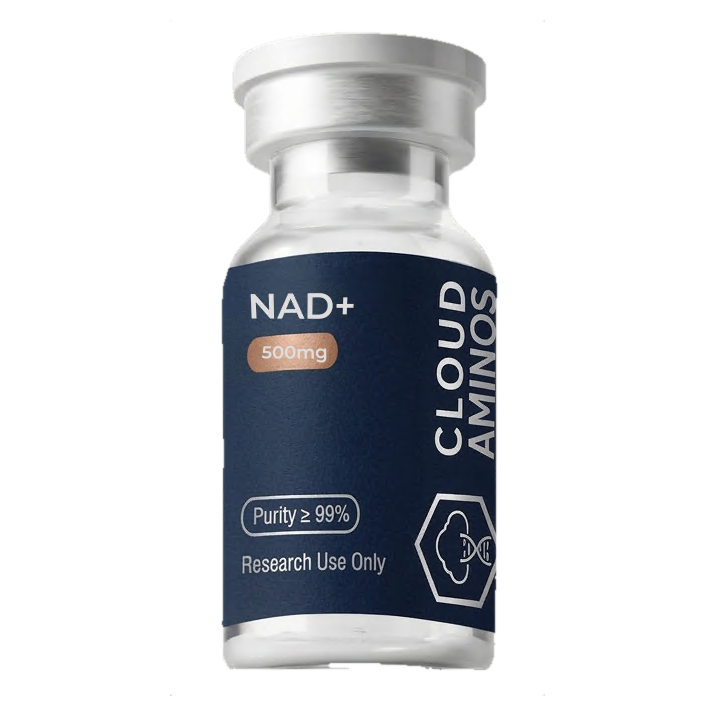
NAD+
Nicotinamide adenine dinucleotide, an essential coenzyme central to cellular-energy and redox research. Studied in longevity, DNA-repair and mitochondrial-function models. Supplied as lyophilised powder.
Size:
Price:
$36.00
Quantity:
Bulk Options:
Free shipment protection on every order. Damaged items are replaced at no cost with photo evidence. Flat $5 UPS Ground shipping (2-5 business days) on every order.
Similar Products
NAD+ Research Overview
NAD+ is a coenzyme found in every living cell, not a peptide. It is central to energy metabolism and DNA repair, declines with age, and is injected or infused by people hoping to restore energy, cognition, and cellular resilience.
Also known as: Nicotinamide adenine dinucleotide, NAD, beta-NAD, Coenzyme 1
Background
NAD+ is not a peptide. It is a small molecule made of two nucleotides joined by their phosphate groups, one containing adenine and the other nicotinamide. It shows up in peptide databases because it is sold as a lyophilized powder in vials, reconstituted with bacteriostatic water, and injected subcutaneously or intramuscularly by the same people who use peptides. It is a coenzyme, meaning it shuttles electrons in hundreds of metabolic reactions and serves as a substrate for sirtuins, PARPs, and CD38.
The aging story is real at the biological level. NAD+ levels fall in many tissues with age, and restoring them in old mice improves mitochondrial function, muscle performance, and some measures of healthspan. Most of that research used precursors such as nicotinamide riboside (NR) or nicotinamide mononucleotide (NMN), which cells can absorb and convert, rather than NAD+ itself. Human trials of those precursors reliably raise blood NAD+ but have shown modest or inconsistent functional benefits so far.
Direct NAD+ administration has much less data. A small Australian pharmacokinetic study of a six-hour intravenous infusion found plasma NAD+ did not rise until about two hours in, suggesting rapid uptake or breakdown, and that the infusion mainly raised nicotinamide and other metabolites. Oral NAD+ is largely broken down in the gut into precursors before absorption. Injected NAD+ probably works, if it works, by being converted to nicotinamide and rebuilt inside cells. The widespread IV clinic and injection use for fatigue, addiction recovery, and anti-aging rests on that plausible but unproven chain.
Mechanistic Profile
Separately from that redox role it is consumed as a substrate by sirtuins, which deacetylate proteins involved in stress resistance and mitochondrial biogenesis, by PARP enzymes that repair DNA, and by CD38, an enzyme that rises with inflammation and age and is a major cause of NAD+ decline. Raising NAD+ availability is thought to restore sirtuin and PARP activity and improve mitochondrial efficiency. Injected NAD+ is not transported intact into most cells; it is likely broken down outside cells into nicotinamide and nicotinamide riboside, which cells take up and rebuild into NAD+.
Reported Research Findings
NAD+ levels decline with age in multiple human and mouse tissues, and restoring them in old mice improves mitochondrial function and muscle performance. (rodent)
Oral NR and NMN reliably raise blood NAD+ in clinical literature in randomized trials, with modest or inconsistent functional benefits. (human RCT)
A six-hour intravenous NAD+ infusion in healthy volunteers did not raise plasma NAD+ until about two hours in, with rapid metabolism to nicotinamide and other products. (human pilot)
CD38 upregulation is a primary driver of age-related NAD+ decline in mice. (rodent)
NAD+ precursors improved outcomes in mouse models of neurodegeneration and metabolic disease. (rodent)
Analytical Validation, Formulation and Storage
Purity: 99% or higher as verified by HPLC, with a third-party certificate of analysis available per batch.
Formulation: lyophilised (freeze-dried) powder in a sterile sealed glass vial, to be reconstituted with an appropriate solvent for laboratory use.
Reported half-life: Minutes in plasma; rapidly metabolized to nicotinamide and other intermediates.
Storage: keep lyophilised material cool, dark and dry (long-term at or below -20 °C). Store reconstituted solutions refrigerated, avoid repeated freeze-thaw cycles and use within laboratory-defined windows.
Selected Literature
A pilot study investigating changes in the human plasma and urine NAD+ metabolome during a 6 hour intravenous infusion of NAD+. Frontiers in Aging Neuroscience, 2019.
Therapeutic potential of NAD-boosting molecules: the in vivo evidence. Cell Metabolism, 2018.
NAD+ intermediates: the biology and therapeutic potential of NMN and NR. Cell Metabolism, 2018.
NAD+ metabolism and its roles in cellular processes during ageing. Nature Reviews Molecular Cell Biology, 2021.
Cloud Aminos supplies NAD+ as a high-purity research material intended strictly for controlled laboratory use in vitro or in established animal models. This compound is not approved as a drug, diagnostic or dietary ingredient and is not manufactured, packaged or marketed for human consumption, self-experimentation, clinical application or any use outside properly designed and ethically approved research protocols.
Chemical Properties
Common Research Questions
NAD+ is a coenzyme found in every living cell, not a peptide. It is central to energy metabolism and DNA repair, declines with age, and is injected or infused by people hoping to restore energy, cognition, and cellular resilience.
Frequently Asked Questions
Customer Reviews
Held up on our own HPLC
NAD+ arrived sealed and lyophilized exactly as described. Processing was fast and the 99%+ purity claim held up against our own HPLC run.
Research Team, Stanford Lab Verified purchase